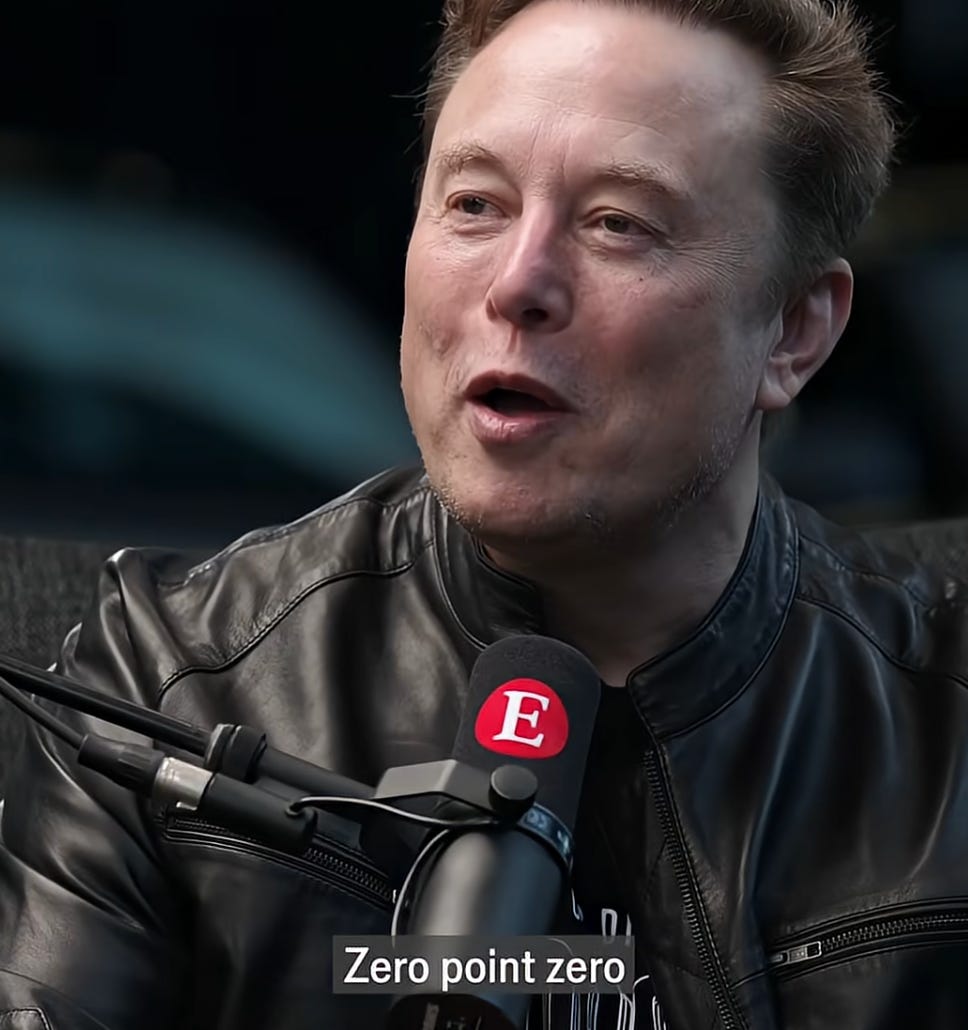
It would be impossible to describe how furiously I screamed “Jesus Tapdancing Christ” at my phone as I watched last week’s interview between Elon Musk and The Economist, where he sat down with Editor in Chief Zanny Minton Beddoes to defend his DOGE cuts to USAID.
This exchange, in particular:
Beddoes: “You don’t buy the idea that anybody … any kid in Africa … died because of the suddenness of the (DOGE cuts to USAID)?”
Musk: “Zero.”
Beddoes: “I just don’t think that’s right … there were huge numbers of things that were shut down in Africa that were health-related…”
Musk: “No, there were claims of this. These claims are false. They’re nonsense. When funding is stopped for fraudulent organizations … do you think they’re going to say ‘please keep funding the fraud,’ or do you think they’re going to come up with a sad story that sounds sympathetic in order to get the funding restored? Obviously it will be the latter, and that’s exactly what they did. Zero died because of DOGE. Zero point zero.”
Now, one would think a modern journalist would see this coming, since Musk and his former employees made the exact same goddamn claims to NPR this same month.
But instead, she stammered and said “I just don’t think that’s right” and then even went on to say she had tremendous sympathy for DOGE’s attempt to reform foreign aid, allowing his insane claim to persist without factual dispute.
So let’s just do that right now.
Worth noting, I found and verified this information with about 30 minutes of research, with all data coming from the Africa CDC and Al Jazeera.
First, DOGE cut between $4-5 billion in aid specifically for sub-saharan African nations just from 2024 to 2025. And while we don’t have the aid figures for 2026 yet, we do have medical data from Africa showing the damage already inflicted by these cuts.
To add insult to injury (or outright death), because of the cuts, most of these nations now have little to no data collection or performance reporting. Because if you’re getting a tiny bit of money, and you have to choose between buying nets to protect children from malaria or performance reporting that helps no one today—but that proves the aid is helping so you can get more aid next year—you’re going to buy the nets.
But we do have one nation that has kept clean records throughout the cuts, and that’s Zimbabwe.
In Zimbabwe, DOGE effectively ended all aid to prevent and treat malaria, and in Zimbabwe, through week 23 of each respective year, here are the outcomes:
In 2024, malaria cases surged from 29,000 to almost 112,000 cases in the same period in 2025.
And in the same period of time, confirmed deaths from malaria jumped from 49 to 310; that’s 4 times as many cases, but 6 times as many deaths.
So far in 2026, with data reported through April, they’ve already reported 65,000 cases and 174 confirmed deaths; both are double last year for the same period of time.
Meaning just in Zimbabwe—and just for malaria—the cuts to USAID have contributed to up to 400 excess deaths; almost entirely children.
Leaving Elon Musk with exactly how much credibility on the subject?